When people walk into St. Paul’s Catholic Church in Ebute Metta, Lagos, they often admire its architecture and peaceful atmosphere. Few realize that the church is also home to one of Nigeria’s most remarkable collections of Africanized Christian art.
These sculptures did not appear by chance. They were carefully commissioned through the shared vision of missionaries, artists, and church leaders who believed that Christianity in Africa should also be expressed through African artistic traditions.
In my previous article, “The Beheaded Priest: How Nigeria’s Most Radical Christian Art Movement Was Forgotten,” I explored how one of Nigeria’s most remarkable collections of Africanized Christian art gradually fell into neglect.
But another question naturally follows.
How did these extraordinary carvings arrive at St. Paul’s Catholic Church in the first place?
Who commissioned them? Who selected the artists? And how did a parish in Ebute Metta become home to one of the country’s most important collections of Yoruba-Christian art?
The truth is that no single document answers all these questions.
There is no surviving acquisition register or church inventory that records exactly when every artwork entered the church. Instead, we must reconstruct the story from the writings of scholars, archival documents, and the records left behind by those directly involved in the Oye-Ekiti Workshop.
When these pieces are brought together, a fascinating story begins to emerge.
The Vision Began Long Before the Church Was Finished
The story begins in Oye-Ekiti.
In 1947, the Society of African Missions established the Oye-Ekiti Workshop under the supervision of Fr. Patrick Kelly, while Fr. Kevin Carroll and Fr. Seán Oliver O’Mahony coordinated its artistic programme. Their vision was both simple and revolutionary: to encourage Yoruba master carvers to produce Christian art using indigenous artistic traditions rather than European models.
Scholars including Nicholas Bridger, John Picton, Ndubisi, and Kevin Carroll all acknowledge that the workshop employed some of the finest Yoruba woodcarvers of the period, producing sculptures that blended Christian theology with Yoruba artistic expression.
The workshop would eventually influence churches throughout southwestern Nigeria—but perhaps nowhere more significantly than St. Paul’s Catholic Church in Ebute Metta.
A Church Designed with Art in Mind
At almost the same time, construction was underway on the present St. Paul’s Catholic Church. Historical records show that Fr. Harry Sheppard, who became parish priest in August 1957, supervised the construction of the new church building. According to Kevin Carroll, it was during this period that he commissioned several artists from the Oye-Ekiti Workshop to produce carvings for newly established churches, including St. Paul’s (Carroll, 1967).
Nicholas Bridger’s research adds an important detail. He notes that Carroll and Sheppard worked closely together from the beginning of the church’s construction. This suggests that the decision to furnish St. Paul’s with Africanized Christian art was never an afterthought. Instead, it formed part of the church’s original vision.
Rather than filling the new building with imported European religious sculptures, they intentionally commissioned Nigerian artists to create works that reflected both Christian faith and Yoruba cultural identity.
Reconstructing the Timeline
Although many acquisition records have been lost, enough evidence survives to establish a reasonably clear chronology.
1961
At the request of Fr. Harry Sheppard, several important works entered the church.
These included:
- The African Madonna, carved by Osagie Osifo
- A monumental crucifix figure, also by Osagie Osifo
- St. Joseph, carved by Festus Idehen
These sculptures became some of the earliest major examples of Yoruba-Christian art installed within the church.
1962
Another milestone followed. The magnificent carved entrance doors created by Lamidi Fakeye—today among the church’s most celebrated artworks—were installed at the main entrance. During the same year, the Baptismal Screen, carved by Otooro of Ketu, was also completed and placed within the church. Evidence further suggests that the Baptismal Font, carved by Bandele, son of Areogun, was installed during the same period. Because the font originally formed part of the baptistery ensemble, it is highly likely that both works entered the church together.
1967
The collection continued to grow.
In 1967, master printmaker and painter Bruce Onobrakpeya completed a series of Stations of the Cross paintings for St. Paul’s Catholic Church, adding another significant chapter to the church’s artistic heritage.
More Than a Collection
What is remarkable about this history is not simply the number of artworks collected, but the deliberate vision behind them. Over roughly a decade, St. Paul’s Catholic Church gradually assembled one of the finest collections of Africanized Christian art in Nigeria. It was not created through a single grand commission.
Instead, it grew steadily—one sculpture, one carving, one painting at a time.
Behind this remarkable achievement stood missionaries who believed Christianity could be authentically expressed through African artistic traditions, together with Yoruba master craftsmen whose extraordinary skill gave that vision lasting form.
Looking Back with New Eyes
Today, many visitors see only individual artworks—the famous Lamidi Fakeye doors, the Madonna, or Bruce Onobrakpeya’s Stations of the Cross. But when we reconstruct the story behind their arrival, something much larger becomes visible. These were never isolated commissions. They formed part of a carefully planned artistic programme that transformed St. Paul’s Catholic Church into one of the most important centres of Africanized Christian art in Nigeria. Understanding how these works came together helps us appreciate not only their artistic beauty but also the remarkable collaboration between missionaries, parish leadership, and Yoruba master carvers that made them possible.
In many ways, the collection tells the story of a Church searching for an authentically African visual language of faith.
And that story is still unfolding.
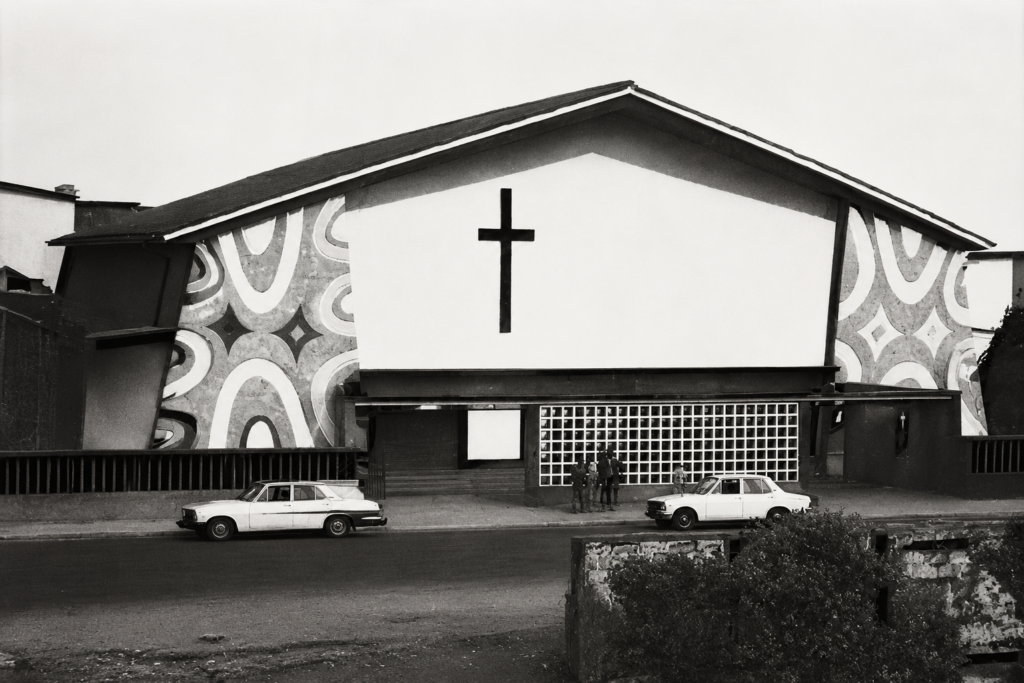
St Paul’s Catholic Church Ebute Metta Lagos. Photographed in 1960 by Fr. Kevin Carroll
ADAH JOANNE