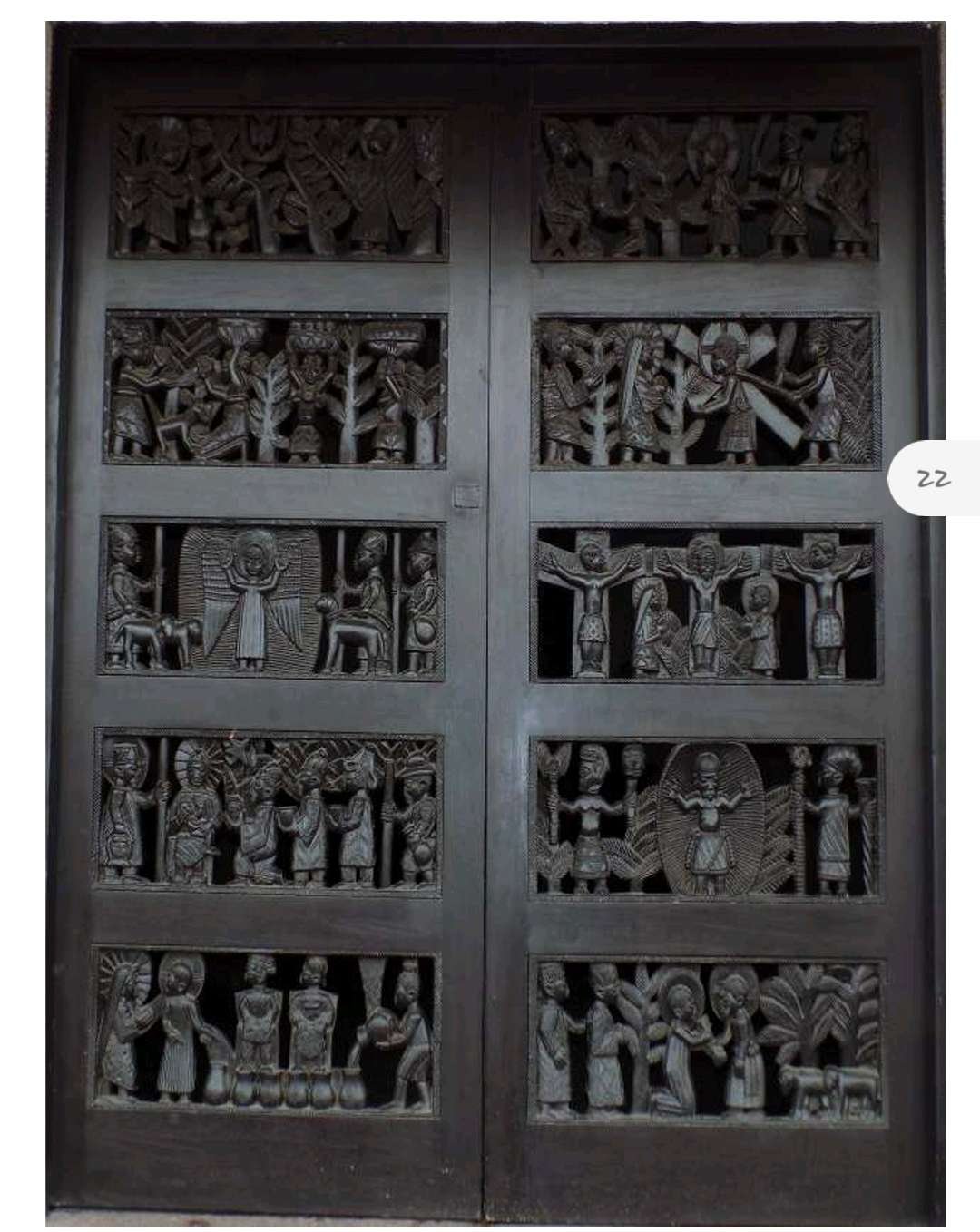
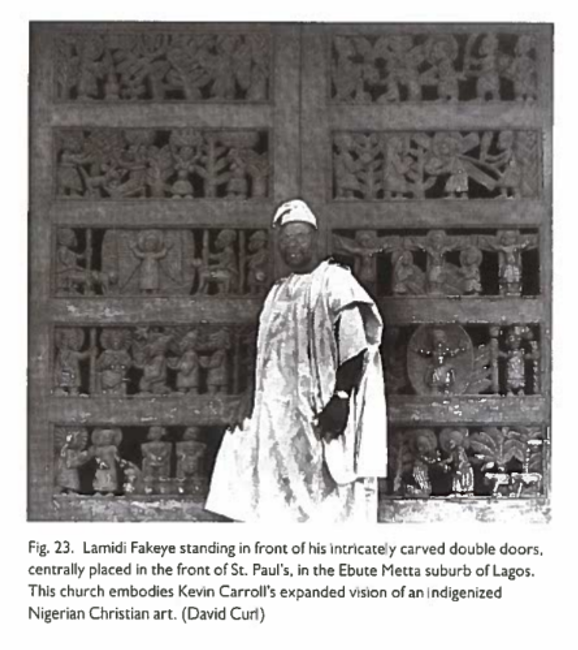
Lamidi Fakeye standing before intricately carved doors at St. Paul’s Catholic Church, Ebute Metta, Lagos. The doors remain standing today as part of the church’s front façade—an enduring example of indigenized Nigerian Christian art
When you think of Christian art, what comes to mind?
For many of us, the images are familiar—paintings of Jesus, Mary, and the disciples that we have seen in churches, books, and online. But have you ever paused to notice something?
These images often don’t reflect the diversity of the global Church.
So where do we see ourselves?
What is Africanized Christian Art?
Africanized Christian art is the portrayal of biblical stories and figures using African features, cultures, symbols, and artistic styles. It is a way of expressing faith that reflects African identity and lived experience.
These are a set of visual art forms that have adopted the carving style of the indigenous African people, depicting themes and subject matter of Christianity to foster evangelization and conversion of the indigenous Yoruba traditional worshipers to Christianity
This form of art is not new. It has existed in different parts of Africa for years, quietly telling powerful stories of faith through local lenses—yet it is not always widely recognized or discussed.
Why does it matter?
For a long time, much of Christian imagery has been shaped by non-African perspectives. While these works are meaningful, they do not fully capture the richness and diversity of believers around the world.
Africanized Christian art helps to bridge that gap.
It reminds us that:
- Faith is not foreign to African identity
- God is present in every culture
- Sacred stories can be told in ways that feel closer to home
A Closer Look at the Image Above
The image above shows master carver Lamidi Fakeye standing before intricately carved church doors in Lagos.
These doors are more than decorative—they are deeply symbolic. The carvings reflect biblical themes expressed through African artistic language, forms, and storytelling traditions.
This is what Africanized Christian art does so powerfully:
it takes familiar faith narratives and expresses them through local identity and craftsmanship.
It is not a replacement of Christianity—it is an inculturation of it.
Art as Identity and Belonging
One of the most powerful aspects of this art form is how it reimagines familiar biblical figures and stories.
Christ may be depicted with African features.
Mary may be shown in traditional fabrics.
Scenes from the Bible may unfold in culturally familiar environments.
These are not just artistic choices—they are statements of identity, dignity, and belonging.
A Biblical Reflection
The Bible reminds us in Genesis 1:27 that we are all created in the image of God. This means that no single culture owns the image of Christ. Rather, every culture reflects a part of God’s beauty.
In Revelation 7:9, we see a vision of people from every nation, tribe, and language standing before God.
That diversity is not only spiritual—it can also be expressed visually, through art.
A Question to Reflect On
What would it mean for more people to see themselves reflected in sacred images?
What would it mean for a young African child to encounter a depiction of Christ that feels familiar—one that speaks their visual and cultural language?
This Is Just the Beginning
This blog is a space to explore these questions.
Each week, we will uncover the beauty, meaning, and significance of Africanized Christian art—highlighting different styles, artworks, and cultural expressions that bring faith closer to home.
This is more than art.
It is identity.
It is faith.
It is representation.
And this is just the beginning.
Adah Joanne
Art is beautiful. With art one can picture imaginary things to reality.
You’ve written this with clarity, intention, and quiet conviction.
What’s especially compelling is how you guided the reader—starting from a familiar perspective and then gently opening up a deeper, often overlooked conversation. There’s a strong sense of balance here: you honor existing traditions while making a confident case for representation and cultural expression within faith.
Your tone is calm but persuasive, and that makes the message land even more. It doesn’t feel forced—it feels revealed.
Keep building this. There’s real depth in how you’re approaching this subject, and it has the potential to shape how people see both art and identity within the context of faith.
This is really well written.
I like how you explained a deep idea in such a clear and calm way. It makes people think without feeling overwhelmed. The balance between faith and culture is handled beautifully.
Keep writing like this—there’s something important in what you’re building.