At the entrance of St. Paul’s Catholic Church, Ebute-Metta, Lagos, stands one of the most remarkable works of Christian art in Nigeria. One of its carved wooden panels depicts a priest of Ṣàngó standing beside the risen Christ—a bold visual statement that Yoruba tradition prepared the way for the Gospel rather than opposed it.
Someone cut off the priest’s head!!!
When the scholar Nicholas Bridger visited the church years later, he found the vandalized door alongside other treasures left to rot: a carved baptismal font gathering dust, a life-size African Madonna pushed into a forgotten corner of a side altar, and a set of Stations of the Cross paintings by master artist Bruce Onobrakpeya quietly decaying from neglect. Apparently, he noted, Africanized Christian art still presents a contested terrain — at least at the parish level.
How did some of the most important works of African Christian art end up dusty, damaged, and disowned by the very church that commissioned them? The answer starts more than six decades earlier, in a small workshop in Oye-Ekiti — with a question the Catholic Church had never really had to ask before: could Christianity look genuinely African and still be authentically Christian?
Now let’s travel back to a small town in present-day Ekiti State, where an extraordinary experiment began.
A Time When African Art Was Rejected
When Catholic missionaries first arrived in Ekiti, in southwestern Nigeria, they ran into a problem. The Yoruba people already had a rich, functioning religious tradition, complete with its own visual language of carved figures and ritual objects. The missionaries didn’t just dismiss this tradition — they actively rejected it, branding Yoruba sculpture as “pagan idols” unfit for anywhere near Christian worship.
That rejection created a deeper problem than the missionaries perhaps realized. To many Yoruba communities, Christianity looked like a foreign religion — foreign images, foreign artistic conventions, foreign ways of worship. If Yoruba worshippers already had a concept of a supreme deity, Olodumare, sitting at the head of their own pantheon, then maybe Jesus Christ didn’t need to be introduced as some unfamiliar outsider god. Maybe he could be shown through a visual language people already trusted.
Could Christianity speak through an African artistic language without losing its Christian identity? That question would inspire one of the most important artistic experiments in Nigerian history.
The Radical Experiment Begins
That rethinking led to the founding of the Oye-Ekiti Workshop in 1947, under Fr. Patrick Kelly, with Frs. Kevin Carroll and Sean Oliver O’Mahoney playing central roles in shaping it. The idea was bold: rather than replacing Yoruba artistic traditions, invite local master woodcarvers to use their existing skills and techniques — the same ones once used to carve deities and ancestral figures — to create Christian sculpture instead.
The result was something genuinely new. Biblical figures were rendered in the forms and proportions of Yoruba sculpture. Christian subjects were expressed through African artistic conventions instead of European ones. This wasn’t decoration bolted onto existing church furniture — it was one of the earliest and most successful examples of what scholars now call inculturation: expressing a faith through local culture rather than importing someone else’s.
Local master carvers took up the challenge — Areogun of Osi, his son Bandele, Lamidi Fakeye, Otooro of Ketu, Osagie Osifo, Festus Idehen, and others. What they produced argued, piece by piece, that African artistic tradition wasn’t an obstacle to Christianity. It could be one of its most powerful vehicles.
From Oye-Ekiti to St. Paul’s Catholic Church: a living Museum.
The workshop’s influence soon reached beyond Ekiti. Between 1957 and 1960, the new building of St. Paul’s Catholic Church in Ebute-Metta was completed under Fr. Harry Sheppard, and Kevin Carroll brought in Oye-Ekiti carvers to produce work for it. What they delivered became some of the movement’s finest achievements:
- The monumental carved entrance doors by Lamidi Fakeye
- The Madonna and a crucifix figure, carved by Osagie Osifo
- St. Joseph, carved by Festus Idehen
Together, these works transformed St. Paul’s into one of the finest examples of Yoruba Christian art in Nigeria. Today, visitors still walk beneath Fakeye’s carved doors on their way into the church — more than sixty years after they were installed. Few realize they’re passing through one of the most significant surviving works of Yoruba Christian art in the country.
When Art Became Controversial
The experiment was artistically successful. It was not without controversy.
There’s a particular irony to what happened next: the very Yoruba carving style that missionaries had once rejected as pagan was now standing inside their own churches, carved into altars and doorways. Some clergy and worshippers pushed back, questioning whether these Africanized Christian images truly belonged in Christian worship, or whether the style carried too much of its original religious meaning ever to be fully separated from it.
Opposition ran deeper than a few skeptics — it moved through indigenous clergy, laypeople, and even college students. The questions being asked were not small ones: Can Christian art look African? Can a traditional artistic form be cleanly separated from the religion it came from? How far should the Church go in adapting itself to local culture — and at what point does adaptation start to look like compromise?
Those questions were never really settled. By around 2012, that unresolved friction had done its damage. Parish priests decided the objects weren’t worth displaying anymore. The art came down. Pieces were shoved into storage rooms, left uncared for. Some were damaged. Others were destroyed outright — burned, or stolen.
It was in that storage that Bridger found the carved baptismal font and screen neglected, the imposing African Madonna obscured and dusty, and Onobrakpeya’s Stations of the Cross badly deteriorated and in need of conservation. But his greatest shock came outside, at the church’s front doors: one of Fakeye’s carved panels had been deliberately vandalized. The priest of Ṣàngó had been beheaded.
Bridger later wrote that he did not have the heart to tell the elderly Fakeye what had happened to his masterpiece.
Why This Story Matters
It’s tempting to treat this as a local, contained tragedy — a handful of carvings neglected in a Lagos parish. But that undersells what was lost.
Christianity has never belonged to one culture alone. It has spoken through Greek mosaics, Byzantine icons, Gothic cathedrals, Ethiopian manuscripts — each one the same Gospel, translated into a different visual language. The Oye-Ekiti carvers were doing exactly that work when they picked up their tools in 1947. The spread of Christianity is one of the central threads running through modern African art history, and yet these particular objects — arguably some of its most important artifacts — remain understudied, and worse, largely forgotten even by the community they were made for.
The beheaded Ṣàngó priest on the St. Paul’s door isn’t just an act of vandalism. It’s a symbol of an argument that was never really settled — about who gets to decide what African Christianity is allowed to look like, and whether a faith can wear a Yoruba face without someone, somewhere, feeling betrayed.
Fakeye, Osifo, Idehen, and their fellow Oye-Ekiti carvers spent years carving a visual answer to that question. More than sixty years later, much of that answer sits quietly in storerooms, waiting to be rediscovered. Perhaps it is time we looked again — not only at these remarkable artworks, but at the stories they continue to tell.
Perhaps preserving these artworks is not only about protecting wood and paint. Perhaps it is about preserving the story of how Christianity found an African voice.
If Christianity has found a visual language in every culture it has encountered throughout history, why should Africa be any different?
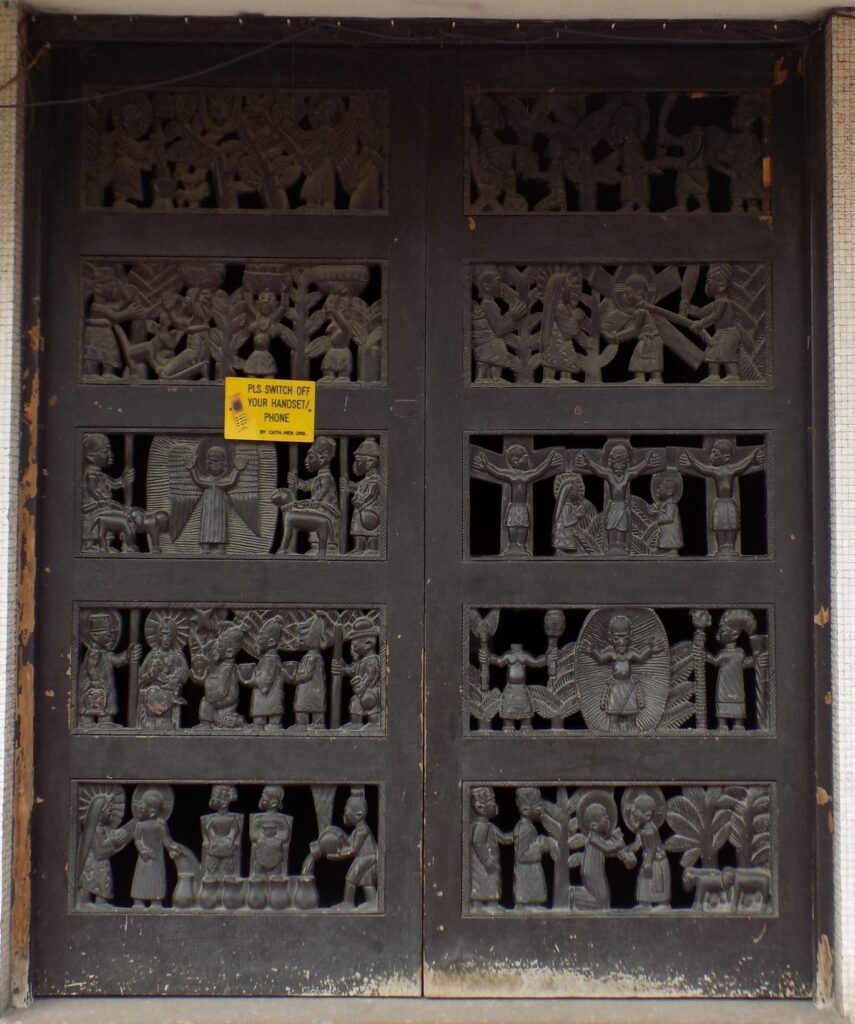
The door panel carved by Lamidi Fakeye at the entrance of St. Paul’s Catholic Church in Ebute Metta. The fourth panel from the top right depicts the priest of Shago with his head beheaded.
Adah Joanne